
a. Palmer Integrated Projects, latest news
The Twelfth Palmer Sculpture Biennial is now open
Works by the following artists are on display in the timeless Palmer Landscape:
International: Carlotta Brunetti (Germany), Titus Eichenberger (Switzerland) and Ivan Smith (UK)
New South Wales: David Jensz.
South Australia: David Atkins, Liz Butler & John Woolford, Jan Clifford, Dr Maarten Daudeij, Eliana Della Flora, Sakthivel Eakambaranathan (emerging artist), Scott Hawkland (emerging artist), John Hayward, Greg Johns, Glenda Kent, David Kerr, Sam Mulcahy, Niccy Pallant, Astra Parker, Liz Ports & Lisa Conolly, Will Powrie, Alan Todd, Westley Tully, Peter Walker, Clancy Warner and Sian Watson.
Victoria: Geoffrey Bartlett.
Western Australia: Johannes Pannekoek
Open Days:
Weekends 11:00 to 5:30 and Wednesday afternoons 2:00 to 5:30 until April 12th.
How to find us:
We are 3.5 km down the Davenport Road which starts opposite the Hotel at Palmer on the way to Mannum.
Pictures of all the works will be displayed in this website after the Biennial has closed.
In the meantime, here is a very insightful review by the very insightful John Neylon of the works that he saw as they were being installed.
It’s Palmer Sculpture Biennial time. Number 12. Climb once more towards ridgetops studded with monumental steel sculptures. These are works by Greg Johns, spanning a twenty-year period. He bought this property in 2002 when it was an over-grazed bit of dirt in desperate need of tlc and vision. Vision Johns had in spades to transform this site into an open-air theatre in which large-scale sculptures could spread their wings, far from the routines of white cube galleries. Not only his sculptures but those of like-minded artists who would embrace the challenge of siting works in vast spaces and creating larger and riskier works than well-established studio routines usually determined. So, the Palmer Sculpture Biennial was born. Launched in 2004, the project has held its course, operating on a shoestring budget, relying on volunteers and the passion of all participating artists. Its sustainability reflects Johns’ own journey of hard-won achievement and recognition in the face of some local prejudice that variously regarded his work as ‘old school modernist’ or ‘patriarchal’. He continued to make solid, durable sculptures against the grain of fashionable art scene tastes which favoured ephemeral materiality and ideology. His current, 50 Year Survey exhibition at Segwood Gallery is testimony to his journey as a thoughtful and determined artist. It‘s proudly old school in its commitment to studio practice evolving from a constant reworking of key motifs, underpinned by a holistic, philosophical framework with connections to belief-based art of many cultures.
But Palmer Sculpture Biennial has always marched to its own drum. While successive Palmers have generally been defined by a respectful conversation between artwork and the land, individual personalities have always shone through. PSB No. 12 is no exception. I touched base with the project a day out from opening. Some works were being completed, and few were scheduled to be sited later in the day. Talking with several artists offered special insights into process particularly in terms of concept development and choice of material and siting. For some, Palmer is now a rehearsed space. I located David Kerr, perched like an Old Man Kangaroo in the shade of a sheoak overlooking a valley which led to farmland in the middle distance. Further back up the hill sits another of his works, Wind Levee, sited in the 2006 PSB. Kerr intended to later get back there to see how it was travelling. Palmer is that kind of open-air gallery – studded with traces of previous works or sites that are incrementally being erased by the weather. Kerr’s current work, A bunch of sticks under tension from ‘Musings on and off the grid Series delivers the kind of sardonic wit and calibrated understatement his audience has come to expect. The work consists of a large upright grid made from tree trunks or branches. The primary source was olive trees. There is a eucalypt sapling and a machined wooden unit (from an old windmill) with a rusted clamp unit at one end. The bark has been pared. The exposed trunk/limbs have a comforting honey-hued quality. To look through this grid to the farmland beyond is to begin a conversation with the artist’s interest in “the space between the Cartesian plane (The Grid) representing ‘The State’ and the space occupied by the Other.” The artist suggests that it might be used as a metaphor to think about the defining boundaries that shape the way we see and live. Sit under that old sheoak and figure it out for yourself.
Framing devices are abundant in the 2026 PSB. Nearby Will Powrie’s Blood and Bone invites the viewer to walk under a circular rotunda and look upwards. Overhead is a snaking tube to which is attached a succession of bones sourced from camel remains the artist had collected from travel in the Central Desert. It reads as the skeleton of an outsized snake. It’s a mix of the macabre and the beautiful, if that’s possible. Sited on the escarpment looking out across the ancient River Murray flood plain makes it easy to join the dots in terms of ecology and sustainability. Powrie’s catalogue statement doesn’t hold back, “River near death, rivers been sold / Rivers bled into concrete arteries… Rivers exposing bleached white bones.” In the company of other works celebrating timelessness and unity with nature Blood and Bone is the ghost at the banquet.
If Powrie’s work is the ghost, then John Hayward’s DendroMimesis – Memorial to the tree is the Cheshire Cat’s Smile. It has a spectral presence that demands the viewer to go close and like a doubting Thomas, put a hand in its side. Touch it. Believe it. It’s basis in the mind of the artist is the ancient Greek’s understanding that all physical matter can be reduced to collections of triangles. Mimesis they understood was the model for beauty and truth. So, we are looking at a representation of treeness. More particularly, a memorial for all trees who once stood here and now eliminated by destructive land clearance. Haywood’s long-term interest is concerned with textures created in the natural environment, particularly tree bark textures. Over time he has developed techniques for capturing and replicating these textures in other materials including fibre glass, bronze and cement. This is one special tree that even up-close gives up its secrets reluctantly. The copper interior, symbolic of hope as the catalogue statement suggests, is inspired. This feature doesn’t have to mean anything. In the total context it just works.
Other works also feed off the grandeur of the east-facing escarpment with its sweeping views. Scott Hawkland’s Protector hovers like a floating Man o’ War. Hawkland’s carved, seed-pod-like sculpture Breathwas one the few standouts in the recent Brighton Jetty Sculpture festival. This Palmer work reflects aspects of Hawkland’s simpatico for the generous lines and patterns that carved timber offers. The upper section looks like a seed pod and the steel rods snaking from its base resemble root-like tendrils. As the wind picked up this unit began to tremble, suggesting organic life on the march. The artist’s statement mentions the term ‘readiness’ and indeed, there is a sense of fine balance between implied stasis and movement which indicates and evolving vocabulary of form. It would be easy at this point to invoke more holistic metaphors of resilience, transition and relationship to the land. But experience the work for what it has to offer as a tiny, tremulous artefact dancing on the edge of time.
You will have seen something like Ivan Smith’s Order v Chaos somewhere before. Think of that corporate toy, the Newton’s Cradle of suspended steel balls sitting in a frame. That’s almost it in a way except the framework is large enough to sight from a few hundred metres and the ‘balls’ are 10 granite rocks suspended from sturdy metal rods. One stone is paused to swing. But it’s a frozen moment. The mildly amusing spectacle of cause and effect will never happen. Smith comments “The result is a meditation on time, stillness and the potential that remains unrealised.” But at Palmer nature will always have something to say. The wind was teasing this immutable structure into thinking it might actually be moving. Fancy fooling a rock.
The wind has a lot to say in Liz Butler and John Woolford’s Sentinels of Season. Unfurled rolls from an old Pianola were being bullied by the rising wind. The artists’ statement talks of the wind defining seasonal change. “The wind becomes music – a quiet expression of cyclical passage – recalling the rise and fall of the seasons.” They refer to the sail-like banners as Sentinels. Pianola scrolls in their opinion act as both material and metaphor for constantly unfolding change. Finely drawn images of birds and flora are a visual bonus. At the centre of this installation, the entrails of an old Pianola sit in a vitrine like a time capsule. There is incongruity in this gesture of pulling a machine apart an exposing it to the elements. The fact that the scrolls are now free to make their own music, and dance around, enlivens the metaphor. Beyond that, logic doesn’t apply. Just enjoy it for what it is, to the tune of Vivaldi’s Four Seasons, courtesy an onsite QR code.
Serendipity infuses Alan Todd’s installation Avian Redux located nearby. It’s a disarmingly simple proposition – dozens of ‘galahs’, sited on a hillside. From a distance they resemble a flock of white cockatoos feeding. Up close they are revealed as simple cut-out units. They carry handwritten inscriptions which read like outtakes from haiku poems. Visitors are invited to contribute their own and post them in the birdbox provided. This used to be called process art. It is a disarmingly simple idea, and it works in terms of viewing engagement.
That appears to be a factor in many works across successive Palmers. Carlotta Brunetti for example, has presented work in three previous Biennials. They have demonstrated a growing confidence in siting large-scale earth works which can be easily read within epic landscapes. Disturbed Ripples consists primarily of sand pathways encircling groups of saplings. A reading favours pond-like protection for living plants, highlighting the vulnerability of vegetation in such an arid environment. It is a bold strategy for directing the viewer’s attention, much like theatrical spotlighting. Its simplicity is its strength.
Astra Parker’s proposition Telluric Field also works the boundaries of simple, geometric forms to consider “how habitable space is shaped – not solely by walls and roofs, but by edges of space, proximity, and collective form.” Large Corten steel units of irregularly proportioned open-sided designs have been grouped in a considered arrangement which offers limitless configurations as the viewer walks around and through them. As with other works in this PSB, it offers a series of framing experiences as points of engagement with the surrounding landscape. They do look like vestigial shelter, echo the tilting movement evident in surrounding geology and look like they belong.
And so the 12th Palmer Sculpture Biennial unfolded. Last minute decisions made. Clancy Warner’s standing figure soon to be joined by two large dogs when they were eventually strong-armed off the ute (The Calling). David Jensz doing battle with granite boulders (“Plumules”), Geoffrey Bartlett’s Study for Orion (revised)crawling up a hillside on yet another ute, towards its chosen site, and Greg Johns’ The Cathedral Of Treesmaking its own optimistic statement in a returning landscape of young Eucalypts.
This is a sample of palmer Sculpture Biennial no. 12. There are twenty-seven artists represented so be prepared to walk the walk but also take in the magnificent setting with its epic skies and sweeping vistas. Asking art works to say things is fraught and always in danger of overreach. But their first task is to be memorable. And that’s something only you can determine.
John Neylon March 2026
John will continue to post on art events for the foreseeable future. We recommend that you subscribe to his Substack postings.
All About Palmer Integrated Projects
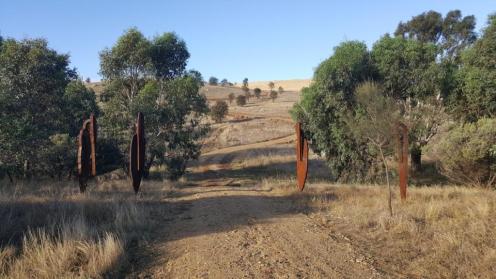
“PALMER BIENNIAL….. is like no other! Big skies, big scapes. An environment that challenges the perception of relationships, of art in landscape. To intrude on an ancient land with a sacred history is Palmer. This needs a particular intellectual sensitivity with a real message.”
Graeme Wilkie – Founder of the Lorne Sculpture Biennale
History and Geography
In 2001 Adelaide sculptor Greg Johns purchased a 400 acre property in the Palmer Hills, 76 kms east of Adelaide. Greg, with the collaboration of Gavin Malone developed the concept of the Palmer Project which encompassed the ecological rehabilitation of the Landscape and the display of both his own works and a range of other contemporary sculpture. More recently, the concept of the Palmer Project has broadened, integrating related endeavours such as ecological education, archaeological and historical research, residencies and seminars in related topics / disciplines and sustainable housing design. Now known as Palmer Integrated Projects, it is evolving as a microcosm of the broad range of issues pertinent to the relationship between art and both ecological and cultural sustainability, part of the challenge facing all humanity. Gavin Malone jointly coordinated the exhibition program and sustainability discourse with Greg for its first eleven years. He is now spending more time on his own work, and the administrative aspects of the project have been taken up by Community Project Management Consultant Bill Clifford.
The small township of Palmer sits at the base of the foothills of the eastern escarpment, from where the land slopes towards the River Murray, about 18km to the east. This is the edge of the mallee country, the rainfall being 400 mm (16 in.) per annum. The area is used for mixed farming, cropping and grazing and the indigenous flora of the area has been almost entirely cleared since European settlement. The Indigenous people and traditional custodians of country are the Peramangk and the area has a rich Indigenous history.
Greg’s place is 3.5 km north of the township on the eastern side of Davenport Road. The locale is known as Rathjen Hill which peaks at a few hundred metres. The 163 hectare (403 acre) property is hilly to undulating with a spectacular rock escarpment and three small creek lines, part of the Reedy Creek Catchment which flows to the River Murray. There is scattered remnant vegetation, the main species being the Rock Grass Tree (Xanthorrhorea quadrangulata), Drooping Sheoak (Allocasuarina verticillata), Golden Wattle (Acacia pycnantha) and River Redgum (Eucalyptus camaldulensis) and numerous native grasses and bulbs.
Sculptural and Cultural Intent
Greg has now placed several of his own works on the property, including new works developed in response to the place. The range of work includes a symbolic reading of the landscape, responding not only to the physical but also the mythical and the spiritual senses of the Australian landscape.
Sculptures are placed in relationship to the whole landscape; it is not a ‘sculpture park’ as such. An exhibition and open day program has commenced and one intent of particular importance is the visitor’s exposure to not only the sculpture but also the ecological landscape, they are symbiotic and interconnected.

Whitewashing History – Clancy Warner – Winner, Artists’ Prize, 2014 Biennial
Palmer Sculpture Biennial
A biennial exhibition was established in 2004 which includes emerging, mid career and established artists, with diverse styles of practice represented. A distinguished artist is also invited to participate. The exhibitions are organised on the basis of artist goodwill and involvement. Artists visit the site and respond to that experience, enabling a range of contemporary sculptural expression with works somehow complementing rather than competing with the enigmatic landscape.
Friends of Palmer
A Friends group has been established to assist with ecological restoration and other activities. Planting days and art/ecology related residencies and seminars are being planned for the future. Please email us at palmersculpturebiennial@gmail.com to be involved.
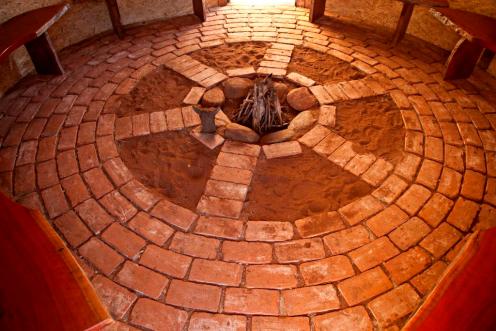
The meeting place from The Round Space – Greg Johns – Photo by Michal Kluvanek
 Palmer Sculpture Biennial